DAY 2 - TABLE MOUNTAIN, BO-KAAP, WATERFRONT AND LONG STREET IN CAPE TOWN
Overnight: Protea Hotel Fire and Ice, Cape Town
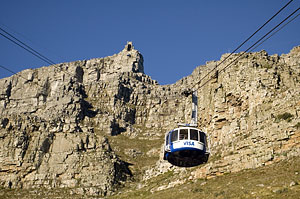
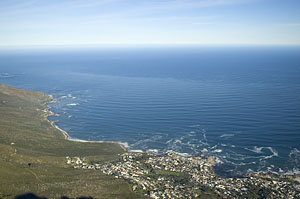
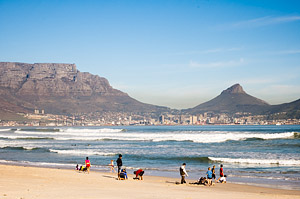
Climbing the Table Mountain in a Cable Car The Table Mountain comes with an element of uncertainty. Once you reach the 3km long level plateau at the top of Table Mountain, you could enjoy the incredible vistas of city and bay or you could be engulfed in a thick cloud cover (the "table cloth"). Now walking in the clouds can be exciting, but I silently prayed for a clear day. When I pulled my window curtains in the morning, I gasped and almost let out swear words. It was a perfectly clear day with spotless and endless blue sky; and the Table Mountain was already glowing in soft morning light. After a sumptuous English breakfast at the hotel (the salty beef sausages were lip smacking awesome), my driver-guide from Cape Caper Tours picked me up at 9 am. Ameen Dhansay took the scenic route from the city to the base of Table Mountain in his Volkswagen van. We parked the car headed for the cable station. The 1086m ascent in the revolving cable car barely took five minutes. The cable station at the other end looked like a tiny speck of concrete precariously balanced on the edge of the mountain. A little overloading and it seemed it would dislodge and come tumbling down. The view from the cable car - sheets of shining sea spread out beyond the glistening towers of the city - was one of a lifetime. Table Mountain is Cape Town's prize treasure. It's a national park and a world heritage site - and very well maintained one. Flanked by Lion's Head on the south and Devil's Peak on the north, every cliff offered an incredible view - Robben Island, Table Bay, Camps and Bantry Bay. One must be a poet to describe the view of Atlantic from here. After spending a couple of hours on the plateau, we came down the Table Mountain (again, in a cable car). It was a great idea to come here early. By the time we descended, queues of parked cars stretched endlessly along the hill and huge crowds had lined up at the bottom cable station. Ameen and I then drove to the other end of the bay to get a full view of the Table Mountain as must have been seen by early settlers who came from the ocean. We continued our drive through the city - the City Hall, city square, main avenue, the castle, District Six, and V&A Waterfront. I looked out of my window and saw young men aimlessly hanging around at signals. "Unemployment is a big problem for us," Ameen explained. "They hang around looking for any casual work. It's worse in the townships where crime and drugs are rampant." Ameen was especially emphatic about District Six. In a cruel decision, the government, during the 60s and 70s evacuated and bulldozed entire neighborhoods in city center. Some 50,000 people we relocated to Cape Flats outside the city. "It was a rainbow neighborhood," Ameen said with some somberness. "All races lived together. But then the government systematically shut facilities, declared it a slum, and moved the people out. This was prime land." Disctrict Six, of course, was in the center of the city. But it lay empty to this date. "The evacuation went too wrong," Ameen continued. "The White builders refused to participate in any development later. In 2000, it was ultimately decided to hand over District Six to original residents. But it's all very difficult now." Life doesn't come without its complexities. I gazed into the emptiness around me. They must have been homes. Several colorful homes with many many families. Only a few mosques and a desolate church stood in the place today.
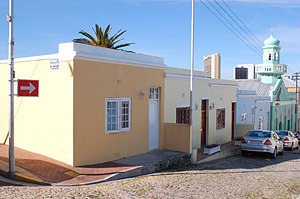
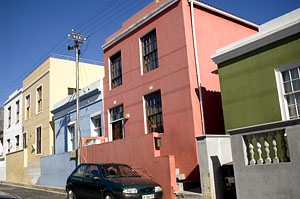
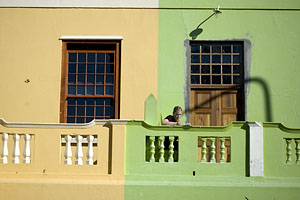
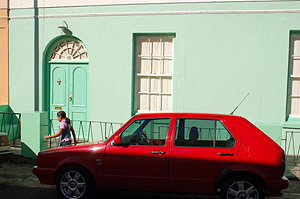
Walking the Colorful Malay Quarters of Bo-Kaap At 1 pm, just as Ameen dropped me in Bo-Kaap, six simultaneously adhaans went off from the minarets of mosques. The Malay quarters of Bo-Kaap ("above the cape" in Afrikaans) was a predominantly Muslim area, and definitely Cape Town's most colorful. Tiny houses dazzled in pastel shades of pink, blue, magenta, voilet, red, yellow and green. I walked towards Biesmiellah Cafe on the corner of a street where 5-6 men in overalls, presumably on a mid-day break from work, stood chatting on the sidewalk. As I walked pass them, one of them confronted me: "Hey! Where you going?" he said in a voice that wasn't naturally rough. "I am going to the restaurant to eat lunch," I told him. "Where? Where you going? You man!" he tried hard to act like a bully. He looked no jerk. Just a normal blue-collar worker on a lunch-time break. His friends looked on from the sidewalk. I pointed to the door: "I am going to the restaurant to eat lunch," I repeated myself maintaining the calm in my voice. At that moment, his friends betrayed him and burst out in a fit of laughter. The guy gave up the pretense and dropped his shoulders. "Mohammed Abdullah," he extended his arm and introduced himself. "Zishaan Hayath," I said shaking his hand. "Pakistan?" "No, India," "Nice to meet you, brother. Do you have cigarette?" "No," I politely shook my head and pushed the restaurant door. "It's a good place to eat," Abdullah shouted over my shoulder. I walked around in the colorful neighborhood. The houses here have had a long tradition of getting their homes painted every year on eid - in bright colors of pastel yellow, pink, blue, green and every color you can (or perhaps cannot) imagine on a wall. While walking through the neighborhood, I struck a conversation with Yusuf Ahmed, a 65 year old entrepreneur who supplied cakes to school canteens. He was so impressed with India and it's rising economy, he implored me that I share ideas with him. "We don't want a million dollars. And a million dollars is a lot of money. We want ideas. The ideas are priceless," he said. And then lowering his voice to a whisper, "You share the ideas with me, and I teach them to my grandson," he added, pointing towards his 6 year old grandson Zaheer. Yusuf was a very intelligent man. A little later, he went in and brought cakes and juice for me. While I ate the fresh home made cakes (he was a baker!), he talked about his travels to Turkey and Mecca and how he remembers an encounter with a citizen of Mecca in 1972. "What we experience, we like to give again," he said. He meant this in a positive way. I wondered if this was true for negative experiences too. I walked further down that cobbled street in Bo-Kaap to stop at a Curio shop. I picked several African wooden masks. Abdullah, the store owner gave me a discount of R110 on a total bill of R350. Abdullah, about 24 years old, too traced his paternal ancestors to India (his mother is a Malay). His brother Ibrahim wanted to visit Calcutta in India because his favorite cricket league (Kolkata Knight Riders) is from that city. He apparently met Shah Rukh Khan once and is his fan ever since. After Bo-Kaap, I picked up a spicy beef sandwich from an Indian store and walked to my hotel.
The Long Night on Long Street Later in the evening, I walked along the Victoria and Albert Waterfront. Unlike most other areas in Cape Town, the V&A Waterfront is a completely safe area after dark. The sashimi dinner at Willoughby and Co. (self proclaimed 'purveyors of fine sea food') was the most generous portion I've had so far (two dinners in a row!). The fish was so good - it melted in my mouth after a dip in soya and wasabi. After Waterfront, it was time to hit Long Street. The Dubliner played live music while Joburg and Marvel did well with Rihanna and other latest numbers. The post midnight hot-dog (crisply fried beef with sweet onions in fresh bread) was pure bliss. And this time, I made sure I took a cab back to the hotel although it was barely 500m away.
Home · Day 3
Tags: Adventure Sports, Africa, Wildlife
Overnight: Protea Hotel Fire and Ice, Cape Town
Climbing the Table Mountain in a Cable Car The Table Mountain comes with an element of uncertainty. Once you reach the 3km long level plateau at the top of Table Mountain, you could enjoy the incredible vistas of city and bay or you could be engulfed in a thick cloud cover (the "table cloth"). Now walking in the clouds can be exciting, but I silently prayed for a clear day. When I pulled my window curtains in the morning, I gasped and almost let out swear words. It was a perfectly clear day with spotless and endless blue sky; and the Table Mountain was already glowing in soft morning light. After a sumptuous English breakfast at the hotel (the salty beef sausages were lip smacking awesome), my driver-guide from Cape Caper Tours picked me up at 9 am. Ameen Dhansay took the scenic route from the city to the base of Table Mountain in his Volkswagen van. We parked the car headed for the cable station. The 1086m ascent in the revolving cable car barely took five minutes. The cable station at the other end looked like a tiny speck of concrete precariously balanced on the edge of the mountain. A little overloading and it seemed it would dislodge and come tumbling down. The view from the cable car - sheets of shining sea spread out beyond the glistening towers of the city - was one of a lifetime. Table Mountain is Cape Town's prize treasure. It's a national park and a world heritage site - and very well maintained one. Flanked by Lion's Head on the south and Devil's Peak on the north, every cliff offered an incredible view - Robben Island, Table Bay, Camps and Bantry Bay. One must be a poet to describe the view of Atlantic from here. After spending a couple of hours on the plateau, we came down the Table Mountain (again, in a cable car). It was a great idea to come here early. By the time we descended, queues of parked cars stretched endlessly along the hill and huge crowds had lined up at the bottom cable station. Ameen and I then drove to the other end of the bay to get a full view of the Table Mountain as must have been seen by early settlers who came from the ocean. We continued our drive through the city - the City Hall, city square, main avenue, the castle, District Six, and V&A Waterfront. I looked out of my window and saw young men aimlessly hanging around at signals. "Unemployment is a big problem for us," Ameen explained. "They hang around looking for any casual work. It's worse in the townships where crime and drugs are rampant." Ameen was especially emphatic about District Six. In a cruel decision, the government, during the 60s and 70s evacuated and bulldozed entire neighborhoods in city center. Some 50,000 people we relocated to Cape Flats outside the city. "It was a rainbow neighborhood," Ameen said with some somberness. "All races lived together. But then the government systematically shut facilities, declared it a slum, and moved the people out. This was prime land." Disctrict Six, of course, was in the center of the city. But it lay empty to this date. "The evacuation went too wrong," Ameen continued. "The White builders refused to participate in any development later. In 2000, it was ultimately decided to hand over District Six to original residents. But it's all very difficult now." Life doesn't come without its complexities. I gazed into the emptiness around me. They must have been homes. Several colorful homes with many many families. Only a few mosques and a desolate church stood in the place today.
Walking the Colorful Malay Quarters of Bo-Kaap At 1 pm, just as Ameen dropped me in Bo-Kaap, six simultaneously adhaans went off from the minarets of mosques. The Malay quarters of Bo-Kaap ("above the cape" in Afrikaans) was a predominantly Muslim area, and definitely Cape Town's most colorful. Tiny houses dazzled in pastel shades of pink, blue, magenta, voilet, red, yellow and green. I walked towards Biesmiellah Cafe on the corner of a street where 5-6 men in overalls, presumably on a mid-day break from work, stood chatting on the sidewalk. As I walked pass them, one of them confronted me: "Hey! Where you going?" he said in a voice that wasn't naturally rough. "I am going to the restaurant to eat lunch," I told him. "Where? Where you going? You man!" he tried hard to act like a bully. He looked no jerk. Just a normal blue-collar worker on a lunch-time break. His friends looked on from the sidewalk. I pointed to the door: "I am going to the restaurant to eat lunch," I repeated myself maintaining the calm in my voice. At that moment, his friends betrayed him and burst out in a fit of laughter. The guy gave up the pretense and dropped his shoulders. "Mohammed Abdullah," he extended his arm and introduced himself. "Zishaan Hayath," I said shaking his hand. "Pakistan?" "No, India," "Nice to meet you, brother. Do you have cigarette?" "No," I politely shook my head and pushed the restaurant door. "It's a good place to eat," Abdullah shouted over my shoulder. I walked around in the colorful neighborhood. The houses here have had a long tradition of getting their homes painted every year on eid - in bright colors of pastel yellow, pink, blue, green and every color you can (or perhaps cannot) imagine on a wall. While walking through the neighborhood, I struck a conversation with Yusuf Ahmed, a 65 year old entrepreneur who supplied cakes to school canteens. He was so impressed with India and it's rising economy, he implored me that I share ideas with him. "We don't want a million dollars. And a million dollars is a lot of money. We want ideas. The ideas are priceless," he said. And then lowering his voice to a whisper, "You share the ideas with me, and I teach them to my grandson," he added, pointing towards his 6 year old grandson Zaheer. Yusuf was a very intelligent man. A little later, he went in and brought cakes and juice for me. While I ate the fresh home made cakes (he was a baker!), he talked about his travels to Turkey and Mecca and how he remembers an encounter with a citizen of Mecca in 1972. "What we experience, we like to give again," he said. He meant this in a positive way. I wondered if this was true for negative experiences too. I walked further down that cobbled street in Bo-Kaap to stop at a Curio shop. I picked several African wooden masks. Abdullah, the store owner gave me a discount of R110 on a total bill of R350. Abdullah, about 24 years old, too traced his paternal ancestors to India (his mother is a Malay). His brother Ibrahim wanted to visit Calcutta in India because his favorite cricket league (Kolkata Knight Riders) is from that city. He apparently met Shah Rukh Khan once and is his fan ever since. After Bo-Kaap, I picked up a spicy beef sandwich from an Indian store and walked to my hotel.
The Long Night on Long Street Later in the evening, I walked along the Victoria and Albert Waterfront. Unlike most other areas in Cape Town, the V&A Waterfront is a completely safe area after dark. The sashimi dinner at Willoughby and Co. (self proclaimed 'purveyors of fine sea food') was the most generous portion I've had so far (two dinners in a row!). The fish was so good - it melted in my mouth after a dip in soya and wasabi. After Waterfront, it was time to hit Long Street. The Dubliner played live music while Joburg and Marvel did well with Rihanna and other latest numbers. The post midnight hot-dog (crisply fried beef with sweet onions in fresh bread) was pure bliss. And this time, I made sure I took a cab back to the hotel although it was barely 500m away.
Home · Day 3
Tags: Adventure Sports, Africa, Wildlife