DAY 5 - WINERY IN PAARL, PATTING A CHEETAH IN STELLENBOSCH AND FRENCH FINE-DINING IN FRANSCHHOEK
Overnight: Le Quartier Francais, Franschhoek
The Wine Route The weather continued to be kind. It was my fifth continuous clear and sunny day in Cape Town. Ameen, my guide from Day 2 picked me up at the Southern Sun. We started driving out on N1. Ameen started talking about why the Cape is also called the 'circle of saints' - several sheikhs who came in as slaves from Indonesia and Malaysia lie buried in this region. He had a very gentle style of speaking and it was a pleasure to listen to him. And like a good guide, he would inject his monologues with occasional wit and humour. We drove past olive plantations, oak trees and African fowls towards the towns of Paarl, Stellenbosch and Franschhoek. Our first stop was the KWV winery. KWV was established in 1918 as a co-operative to regulate wine production in Paarl. KWV is now a private company and is credited with shaping the wine industry of South Africa over the last few decades. The vineyards came to South Africa in 1652 with the Dutch. But the really good ones came here only in 1688 when the Hugenots came here fleeing prosecution in France. Christa Olivier of KWV took me on a tour of the winery. Since I was the only one around, it essentially became a private tour. When we pushed open the huge cellar doors, a strong aroma would hit my nose. Remember all those adjectives your waiter would splutter out when presenting a wine to you for tasting - woody, okay, plum, spicy, fruity - yeah, all of those and more. South African wine is still fermented in barrels imported from France and US. The South African oak grows too fast due to heat and does not have the same fine grain as European or American oak. One of the cellars, Christa told me, was also in the Guiness Book of Records for 5 largest barrels. At a capacity of 200,000 litres, the barrel emptied a bottle a day can last 750 years.
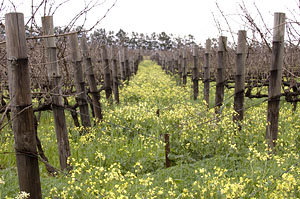
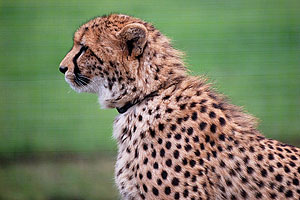
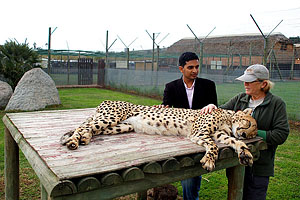
Patting a Cheetah We continued driving through beautiful winelands, although now dry because of winter. Some of the vineyards had rose plantations on the boundary. If you are guessing the roses are planted to give the wine a fragrance, hold your horses. They are there to detect any virus threats to the wines. We stopped at the Spier wine estate. Spier donated land to support the Cheetah Outreach Program that hand-raises cheetahs in the farm. For a donation of R90, you can pat an adult cheetah's. For R180, you can play with cheetah cubs. The donations support Cheetah Outreach Program and Cheetah Conservation Fund (CCF). After I made the donation, a volunteer was happy to take me inside the enclosure of an adult cheetah. "You will have to walk along the sides and approach Hemmingway from the rear. You can pat his back but please don't rub his face or tail. Be gentle with the cat. Use only your palms to pat him." the volunteer instructed. Hemmingway was a 4 year old young adult and at 60 kilos, it was already the largest cat on the farm. The cheetahs live for about 10-12 years in captivity. They would survive for about 8-10 years in the wild. The volunteer explained that many cheetahs were shot by farmers to save their livestock. Now the farm also breeds Anatolian dogs that can be given away to farmers. The dogs scare away cheetahs off the farms and therefore save them from being hunted. While the volunteer spoke about Hemmingway, I gently patted his back. A few minutes later, he rose from his lying position to sit up and purr. Remember, the cheetahs cannot roar. They can only purr. After a unreal fifteen minutes with Hemmingway, I stepped outside his enclosure. As I returned my badge, I saw a cute little board hanging on the gate: "Enter at your own risk" The cheetah is originally an Indian cat. It's such a shame that this magnificent cat is extinct in India!
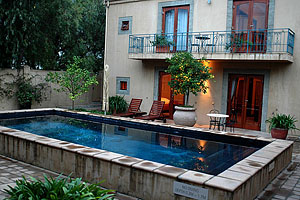
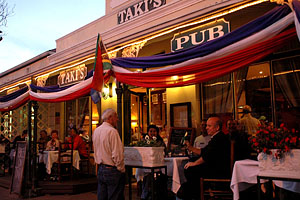
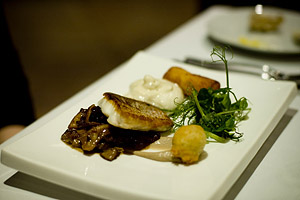
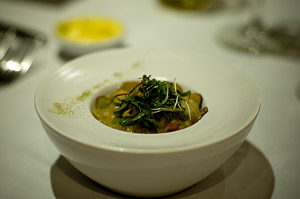
A Date with French Food in Franschhoek We drove past the varsity town of Stellenbosch to reach Franschhoek by evening. Franschhoek is a small town nestled in the lap of beautiful hills. Originally settled by Hugenots from France, the town still retains its French flavor. It was the eve of Bastille Day and the town was gearing up for the celebrations. Ribbons and curtains in French colors - red, white and blue - adorned all shops and businesses. The town goes to sleep at 6 pm but that is when the dining scene in Franschhoek comes alive. Local and international travelers flock to the superb restaurants and bistros in Franschhoek to experience the French culinary delights. I stayed at Le Quartier Francais, an auberge with exclusive accommodation and an excellent restaurant in Franschhoek. As our car drove into Le Quartier, Linda Coltart, the General Manager of the property came out to greet us. While we made our introductions, my luggage shifted with magical accuracy and invisibility from the car into their luxury suite - The Four Quarters. It was as if all life in Le Quartier was in precision mode. I walked into the reception with Linda to meet Susan Huxter, the owner of Le Quartier. The reception was a glowing room with an active yet invisible staff, a huge DVD collection on one wall and a cat on the sofa. Susan extended a warm welcome and kind of surprised me as she had already seen my blog before we met. She asked where would I prefer the evening dinner - the tasting room or the restaurant. Le Quartier's tasting room and restaurant have been voted as the best in Asia, Africa and #37 in the world. The tasting room offered a delightful French meal of eight courses carefully paired with wines. "I have arranged for Eleanor to accompany you on dinner this evening," Susan said. Eleanor was Le Quartier's Food and Beverages manager. "Eating alone is too boring," Susan shook her head. "I would never do that." The meal lasted a little shy of three hours. Jasper, a graduate from a hospitality school in Netherlands who was on a 20 week internship with Le Quartier, waited on us. As we progressed through the courses, the plates, forks and glasses moved around us like a synchronized ballet. The chef, Margot Janse, threw in another two complimentary courses in the eight course meal. The courses sometimes were made with local seasonal produce - fresh pomegranates or juicy crabs from the Namibia coast. Were those 3 hours a long meal with conversations? Or a long conversation with meals in between? At the end of it, I was so full, I could have died and gone straight to heaven. Eleanor joked, "Oh, please don't worry. Our rooms are downhill from the tasting room. And we have a wheel barrow right outside the restaurant should one collapse."
Home · Day 6
Tags: Adventure Sports, Africa, Wildlife
Overnight: Le Quartier Francais, Franschhoek
The Wine Route The weather continued to be kind. It was my fifth continuous clear and sunny day in Cape Town. Ameen, my guide from Day 2 picked me up at the Southern Sun. We started driving out on N1. Ameen started talking about why the Cape is also called the 'circle of saints' - several sheikhs who came in as slaves from Indonesia and Malaysia lie buried in this region. He had a very gentle style of speaking and it was a pleasure to listen to him. And like a good guide, he would inject his monologues with occasional wit and humour. We drove past olive plantations, oak trees and African fowls towards the towns of Paarl, Stellenbosch and Franschhoek. Our first stop was the KWV winery. KWV was established in 1918 as a co-operative to regulate wine production in Paarl. KWV is now a private company and is credited with shaping the wine industry of South Africa over the last few decades. The vineyards came to South Africa in 1652 with the Dutch. But the really good ones came here only in 1688 when the Hugenots came here fleeing prosecution in France. Christa Olivier of KWV took me on a tour of the winery. Since I was the only one around, it essentially became a private tour. When we pushed open the huge cellar doors, a strong aroma would hit my nose. Remember all those adjectives your waiter would splutter out when presenting a wine to you for tasting - woody, okay, plum, spicy, fruity - yeah, all of those and more. South African wine is still fermented in barrels imported from France and US. The South African oak grows too fast due to heat and does not have the same fine grain as European or American oak. One of the cellars, Christa told me, was also in the Guiness Book of Records for 5 largest barrels. At a capacity of 200,000 litres, the barrel emptied a bottle a day can last 750 years.
Patting a Cheetah We continued driving through beautiful winelands, although now dry because of winter. Some of the vineyards had rose plantations on the boundary. If you are guessing the roses are planted to give the wine a fragrance, hold your horses. They are there to detect any virus threats to the wines. We stopped at the Spier wine estate. Spier donated land to support the Cheetah Outreach Program that hand-raises cheetahs in the farm. For a donation of R90, you can pat an adult cheetah's. For R180, you can play with cheetah cubs. The donations support Cheetah Outreach Program and Cheetah Conservation Fund (CCF). After I made the donation, a volunteer was happy to take me inside the enclosure of an adult cheetah. "You will have to walk along the sides and approach Hemmingway from the rear. You can pat his back but please don't rub his face or tail. Be gentle with the cat. Use only your palms to pat him." the volunteer instructed. Hemmingway was a 4 year old young adult and at 60 kilos, it was already the largest cat on the farm. The cheetahs live for about 10-12 years in captivity. They would survive for about 8-10 years in the wild. The volunteer explained that many cheetahs were shot by farmers to save their livestock. Now the farm also breeds Anatolian dogs that can be given away to farmers. The dogs scare away cheetahs off the farms and therefore save them from being hunted. While the volunteer spoke about Hemmingway, I gently patted his back. A few minutes later, he rose from his lying position to sit up and purr. Remember, the cheetahs cannot roar. They can only purr. After a unreal fifteen minutes with Hemmingway, I stepped outside his enclosure. As I returned my badge, I saw a cute little board hanging on the gate: "Enter at your own risk" The cheetah is originally an Indian cat. It's such a shame that this magnificent cat is extinct in India!
A Date with French Food in Franschhoek We drove past the varsity town of Stellenbosch to reach Franschhoek by evening. Franschhoek is a small town nestled in the lap of beautiful hills. Originally settled by Hugenots from France, the town still retains its French flavor. It was the eve of Bastille Day and the town was gearing up for the celebrations. Ribbons and curtains in French colors - red, white and blue - adorned all shops and businesses. The town goes to sleep at 6 pm but that is when the dining scene in Franschhoek comes alive. Local and international travelers flock to the superb restaurants and bistros in Franschhoek to experience the French culinary delights. I stayed at Le Quartier Francais, an auberge with exclusive accommodation and an excellent restaurant in Franschhoek. As our car drove into Le Quartier, Linda Coltart, the General Manager of the property came out to greet us. While we made our introductions, my luggage shifted with magical accuracy and invisibility from the car into their luxury suite - The Four Quarters. It was as if all life in Le Quartier was in precision mode. I walked into the reception with Linda to meet Susan Huxter, the owner of Le Quartier. The reception was a glowing room with an active yet invisible staff, a huge DVD collection on one wall and a cat on the sofa. Susan extended a warm welcome and kind of surprised me as she had already seen my blog before we met. She asked where would I prefer the evening dinner - the tasting room or the restaurant. Le Quartier's tasting room and restaurant have been voted as the best in Asia, Africa and #37 in the world. The tasting room offered a delightful French meal of eight courses carefully paired with wines. "I have arranged for Eleanor to accompany you on dinner this evening," Susan said. Eleanor was Le Quartier's Food and Beverages manager. "Eating alone is too boring," Susan shook her head. "I would never do that." The meal lasted a little shy of three hours. Jasper, a graduate from a hospitality school in Netherlands who was on a 20 week internship with Le Quartier, waited on us. As we progressed through the courses, the plates, forks and glasses moved around us like a synchronized ballet. The chef, Margot Janse, threw in another two complimentary courses in the eight course meal. The courses sometimes were made with local seasonal produce - fresh pomegranates or juicy crabs from the Namibia coast. Were those 3 hours a long meal with conversations? Or a long conversation with meals in between? At the end of it, I was so full, I could have died and gone straight to heaven. Eleanor joked, "Oh, please don't worry. Our rooms are downhill from the tasting room. And we have a wheel barrow right outside the restaurant should one collapse."
Home · Day 6
Tags: Adventure Sports, Africa, Wildlife