Day 2 - Table Mountain, Bo-Kaap, Waterfront and Long Street in Cape Town
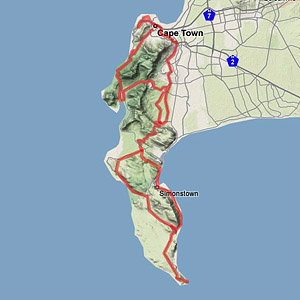
Day 3 - Cape Peninsula in a vintage motorcycle sidecar
Day 4 - Shark cage diving in Gansbaai
Day 5 - Winery in Paarl, patting a cheetah in Stellenbosch and French fine-dining in Franschhoek
Day 6 - The flights back home
Trip Sponsors


PROLOGUE - HOW IT ALL BEGAN
Location: Mumbai, India
A Contest for Travelers Who Blog
So it all started in April first week when my friend Abhishek Thakkar sent me the link to the Fantastic Five - The South Africa Chapter microsite on www.in.com. It asked "Is traveling in your blood and blogging your second nature?" Aye aye sir! Those who answered in affirmative could win a five day trip to a city in South Africa. Too good to be true? Yeah, too good to be true. I checked the sponsors - South Africa Tourism and South African Airways - and it all looked good.
I promptly filled out the form and submitted my entry. The contest closed on 15th May and on 19th I got an email from Radha Barooah saying I was shortlisted for the final auditions in Bombay. I could have jumped six feet into the air at that moment.
Ten people were shortlisted for the auditions - Arjun, Chhavi, Hrish, Pallavi, Rohit, Sasha, Sumanyu, Swapnali, Yudhajit and I - and were supposed to make a 5-7 slide presentation on one of their previous travels. Five finalists out of these ten would be sent to five different cities in South Africa for five days. I crossed my fingers and waited for the auditions on 5 Jun at TV18 Studios in Lower Parel.
The Auditions at TV18 Studios
On the day of the auditions, I met six other passionate travelers (others couldn't make it for various reasons). Radha and her colleagues were busy shuffling through the papers to arrange the auditions. We were to go in one after the other for the presentations. As the initial candidates went into the audition room, I settled into the guest room sofa and waited for my turn.
About half an hour later, Radha came running down the corridor and called my name.
"Zishaan, you are up next."
I walked to the audition room with her through a long corridor between bustling colorful desks and glass cabins. All was calm till I entered the room - a TV studio. But as I entered the dark room, my heart skipped a beat (was I nervous?) My eyes adjusted to the darkness, and I saw a chair and desk with a spot light on it. This was the hot seat. 5 yards away in front of the desk were seated 4 jury members - Suresh Venkat, Harsha Subramanium, Rishi Khiani and Medha Sampat. Medha, I understood, headed the South Africa Tourism Board in India.
"You have 5 minutes for your presentation," Suresh said.
My presentation was projected on a large white screen beside us. I started with a shaky introduction about myself and moved on to the slides. They were titled 'New York, I Love You!' and were a hash of human emotion and neighborhoods in New York City (e.g. Surprise in Meat Packing, Optimism in Greenwich, Awe in Harlem etc.) After the slides, the jury started with their questions and I think the session went off well till Suresh, seated on the extreme right, asked me if my list of '100 Things To Do in Bombay' was original.
"Yes, it is," I told him.
"So tell me a few of your favorite Bombay experiences," he said.
I mumbled something for the next two minutes which I am not sure made a good impression on Suresh. So my auditions went okay but ended on a slight low. After the presentation we all headed back to our work places / friends. Radha told us that the results would be announced on 8 Jun, Monday.
After a Saturday and Sunday that seemed incredibly long, Monday came and went. No word on results yet. Tuesday, a very long one, came and went too. Still no word. Finally on Wednesday, i.e. after five days of killing suspense, I got an email which read, "Hi Zishaan, Congratulations! You have been selected to go to South Africa."
w00t! Chhavi, Hrish, Rohit and Swapnali were the four other finalists!DAY 1 - CROSSING THE EQUATOR INTO THE SOUTHERN HEMISPHERE
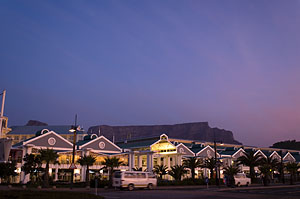
Overnight: Protea Hotel Fire and Ice, Cape Town
Bombay to Johannesburg to Cape Town For the first time in my 27 years, I crossed the equator into the southern hemisphere. After an overnight flight from Bombay, I reached Joburg airport at 0800 hrs local time. My onward flight to Cape Town was scheduled for 1200 hrs. Peter from South African Discoveries received us at the airport, handed our tour tickets and got us a mobile phone recharge from Vodacom. I then went to change $200 to South African Rands. At $1 = 7.81 ZAR, it looked like a sweet deal. However, 50 rands for transaction charges and another 45 for admin charges plus the tax didn't leave the deal sweet anymore. I lost about 100 rands on 1550. Too bad. Next time, I should remember to just withdraw money from an ATM. It was pleasantly cold inside the airport. It must have been single-digit degree centigrade outside. The tag lines of ads in restrooms did catch my attention - 'Better Sex Naturally' and 'Beat the Babalas' - but did not convey what products they sold. South Africa's domestic airline Mango had the best colored planes I have ever seen - bright orange! At 1200 hrs, I boarded the plane from Joburg to Cape Town. Note to self: Never ever change money at the airport or hotel. Pay using credit cards or withdraw cash at an ATM.
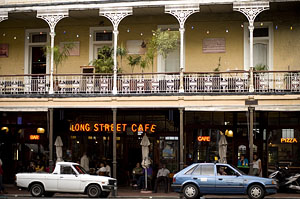
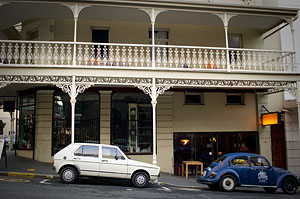
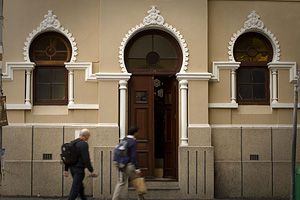
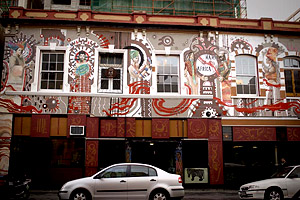
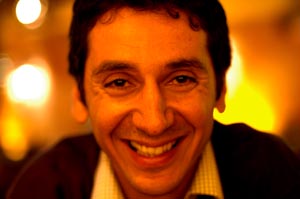
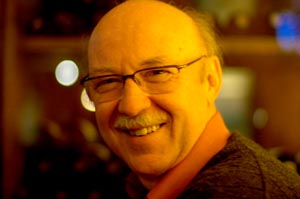
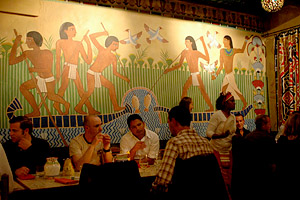
"We have landed in Cape Town. It's a beautiful day out there." After a 2 hour flight across the South African country, the aircraft began its descent from 10,000m towards the blanket of clouds that covered Cape Town city. As the plane plunged into the clouds and emerged on the other side, a scintillating array of tiny houses shone back at us. The city was in no hurry. The townships looked neatly arranged with vast stretches of green scattered between them. As we moved closer to the ground, I could tell the colors of homes - green, blue, red, white, but mostly ochre and brick-red. Some townships were concrete gray - still under construction. The townships were laid out on a green plain that gently sloped up and down - which, I later learnt, were the Cape Flats. A vast deep blue ocean washed the shores of this green plain; it's borders laced with white surf. And on one side lay the majestic Table Mountain, squatting mightily at the edge of the city. Our aircraft flew over the townships and now onto the ocean. And with one giant swoop and u-turn, provided breathtaking views of the bay, coast, city and suburban townships. The plane dived for the runaway, and a thud later, the flight captain announced, "Ladies and gents. We have landed in Cape Town. It's a beautiful day out there." Faldi from Cape Caper Tours picked me up at the airport and drove to the city. Cape Town had impressive roadways. I looked out of the window and asked, "Is that the Table Mountain?" "No, that's the Devil's Peak. Everyone new to the city thinks it's the Table Mountain. You'll see Table Mountain from your hotel." After a short drive from the airport, Faldi dropped me at Protea Hotel - Fire and Ice. The reception knew my name before I stepped in. They put a nice little personal note (with my picture!) in the lobby. My room had another personal note and many small little gifts. I thought the staff was courteous and warm to me because I was here on an invitation from SATB. Later, I figured that all their guests had similar personalised touches to their stay. I really liked the R bracelet (Respect, Recognition and Responsibility) the hotel left for me in my room. In the evening, I walked along Long Street. Long Street is the night life hub of Cape Town - a sort of must-do-for-tourists thing. In a little mosque on Long Street, I met two gentlemen - Lyes Kadem, a young Algerian muslim living and working as a professor in Montreal, and Louis-Gilles Durand, a French speaking Canadian heading a research lab in Montreal. We struck up a conversation outside the mosque and later had dinner at Nyoni's Kraal.
"Will this guy wake up at 5 am to kill a student?" At dinner, Lyes talked about life in Algeria and how a right wing political party would campaign for elections saying, "You must vote for us or else face the wrath of Allah." As simple as that. "The right wingers would one day declare 'No universities' and no universities it is. Anybody attending university is threatened with life," Lyes continued. "In such situations, life becomes strange. You have to think about it and take a call -- 'I take the 5:30 am train to the university. Will this guy wake up so early to kill me? If he does, then he deserves to get me.' -- There is nothing you can do about it. And life thus continues." Lyes' hypothetical dilemma about identity was engaging. Who was he first? A Muslim. An Algerian. An African. A Mediterranean. A French speaking immigrant in Canada. All of these? None of these? There is no doubt that man's identity is the single biggest source of conflict in history. Our occidental vs. oriental conversations continued and ranged from Indian zero, Arabic numerals, the American civilization, life in Algeria, the cultural baggage in India, the language split in Canada to the problems of the Muslim world. Nyoni's Kraal had a nice touch of Africa both in decor and menu. It served a lot of braai meats. Each portion served here could easily serve three! Lyes' chicken was manageable but Louis-Gilles mutton chops and my T-bone steak could as well serve two people if not three. "Enjoy your meal, you are in Africa!" our waitress smiled on our surprise at the large portions. After the meal, I walked back to my hotel. It was 7:30 pm, but the roads were completely deserted. By the end of the uphill walk to my hotel, my heart began to pound inside my chest. And exhaustion was not the only reason. Note to self: There must be a reason why I was the only person walking on the road at that hour. Next time, just take a cab.
DAY 2 - TABLE MOUNTAIN, BO-KAAP, WATERFRONT AND LONG STREET IN CAPE TOWN
Overnight: Protea Hotel Fire and Ice, Cape Town
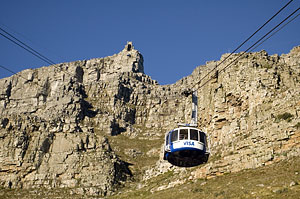
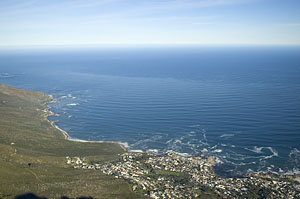
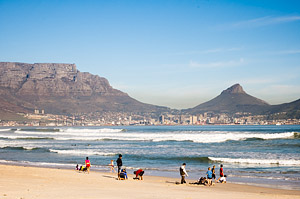
Climbing the Table Mountain in a Cable Car The Table Mountain comes with an element of uncertainty. Once you reach the 3km long level plateau at the top of Table Mountain, you could enjoy the incredible vistas of city and bay or you could be engulfed in a thick cloud cover (the "table cloth"). Now walking in the clouds can be exciting, but I silently prayed for a clear day. When I pulled my window curtains in the morning, I gasped and almost let out swear words. It was a perfectly clear day with spotless and endless blue sky; and the Table Mountain was already glowing in soft morning light. After a sumptuous English breakfast at the hotel (the salty beef sausages were lip smacking awesome), my driver-guide from Cape Caper Tours picked me up at 9 am. Ameen Dhansay took the scenic route from the city to the base of Table Mountain in his Volkswagen van. We parked the car headed for the cable station. The 1086m ascent in the revolving cable car barely took five minutes. The cable station at the other end looked like a tiny speck of concrete precariously balanced on the edge of the mountain. A little overloading and it seemed it would dislodge and come tumbling down. The view from the cable car - sheets of shining sea spread out beyond the glistening towers of the city - was one of a lifetime. Table Mountain is Cape Town's prize treasure. It's a national park and a world heritage site - and very well maintained one. Flanked by Lion's Head on the south and Devil's Peak on the north, every cliff offered an incredible view - Robben Island, Table Bay, Camps and Bantry Bay. One must be a poet to describe the view of Atlantic from here. After spending a couple of hours on the plateau, we came down the Table Mountain (again, in a cable car). It was a great idea to come here early. By the time we descended, queues of parked cars stretched endlessly along the hill and huge crowds had lined up at the bottom cable station. Ameen and I then drove to the other end of the bay to get a full view of the Table Mountain as must have been seen by early settlers who came from the ocean. We continued our drive through the city - the City Hall, city square, main avenue, the castle, District Six, and V&A Waterfront. I looked out of my window and saw young men aimlessly hanging around at signals. "Unemployment is a big problem for us," Ameen explained. "They hang around looking for any casual work. It's worse in the townships where crime and drugs are rampant." Ameen was especially emphatic about District Six. In a cruel decision, the government, during the 60s and 70s evacuated and bulldozed entire neighborhoods in city center. Some 50,000 people we relocated to Cape Flats outside the city. "It was a rainbow neighborhood," Ameen said with some somberness. "All races lived together. But then the government systematically shut facilities, declared it a slum, and moved the people out. This was prime land." Disctrict Six, of course, was in the center of the city. But it lay empty to this date. "The evacuation went too wrong," Ameen continued. "The White builders refused to participate in any development later. In 2000, it was ultimately decided to hand over District Six to original residents. But it's all very difficult now." Life doesn't come without its complexities. I gazed into the emptiness around me. They must have been homes. Several colorful homes with many many families. Only a few mosques and a desolate church stood in the place today.
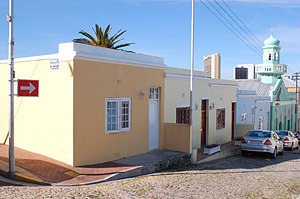
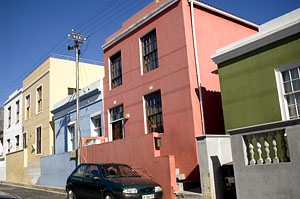
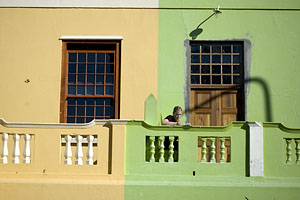
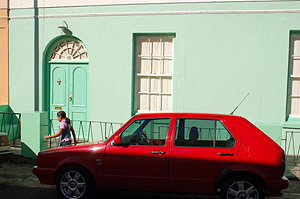
Walking the Colorful Malay Quarters of Bo-Kaap At 1 pm, just as Ameen dropped me in Bo-Kaap, six simultaneously adhaans went off from the minarets of mosques. The Malay quarters of Bo-Kaap ("above the cape" in Afrikaans) was a predominantly Muslim area, and definitely Cape Town's most colorful. Tiny houses dazzled in pastel shades of pink, blue, magenta, voilet, red, yellow and green. I walked towards Biesmiellah Cafe on the corner of a street where 5-6 men in overalls, presumably on a mid-day break from work, stood chatting on the sidewalk. As I walked pass them, one of them confronted me: "Hey! Where you going?" he said in a voice that wasn't naturally rough. "I am going to the restaurant to eat lunch," I told him. "Where? Where you going? You man!" he tried hard to act like a bully. He looked no jerk. Just a normal blue-collar worker on a lunch-time break. His friends looked on from the sidewalk. I pointed to the door: "I am going to the restaurant to eat lunch," I repeated myself maintaining the calm in my voice. At that moment, his friends betrayed him and burst out in a fit of laughter. The guy gave up the pretense and dropped his shoulders. "Mohammed Abdullah," he extended his arm and introduced himself. "Zishaan Hayath," I said shaking his hand. "Pakistan?" "No, India," "Nice to meet you, brother. Do you have cigarette?" "No," I politely shook my head and pushed the restaurant door. "It's a good place to eat," Abdullah shouted over my shoulder. I walked around in the colorful neighborhood. The houses here have had a long tradition of getting their homes painted every year on eid - in bright colors of pastel yellow, pink, blue, green and every color you can (or perhaps cannot) imagine on a wall. While walking through the neighborhood, I struck a conversation with Yusuf Ahmed, a 65 year old entrepreneur who supplied cakes to school canteens. He was so impressed with India and it's rising economy, he implored me that I share ideas with him. "We don't want a million dollars. And a million dollars is a lot of money. We want ideas. The ideas are priceless," he said. And then lowering his voice to a whisper, "You share the ideas with me, and I teach them to my grandson," he added, pointing towards his 6 year old grandson Zaheer. Yusuf was a very intelligent man. A little later, he went in and brought cakes and juice for me. While I ate the fresh home made cakes (he was a baker!), he talked about his travels to Turkey and Mecca and how he remembers an encounter with a citizen of Mecca in 1972. "What we experience, we like to give again," he said. He meant this in a positive way. I wondered if this was true for negative experiences too. I walked further down that cobbled street in Bo-Kaap to stop at a Curio shop. I picked several African wooden masks. Abdullah, the store owner gave me a discount of R110 on a total bill of R350. Abdullah, about 24 years old, too traced his paternal ancestors to India (his mother is a Malay). His brother Ibrahim wanted to visit Calcutta in India because his favorite cricket league (Kolkata Knight Riders) is from that city. He apparently met Shah Rukh Khan once and is his fan ever since. After Bo-Kaap, I picked up a spicy beef sandwich from an Indian store and walked to my hotel.
The Long Night on Long Street Later in the evening, I walked along the Victoria and Albert Waterfront. Unlike most other areas in Cape Town, the V&A Waterfront is a completely safe area after dark. The sashimi dinner at Willoughby and Co. (self proclaimed 'purveyors of fine sea food') was the most generous portion I've had so far (two dinners in a row!). The fish was so good - it melted in my mouth after a dip in soya and wasabi. After Waterfront, it was time to hit Long Street. The Dubliner played live music while Joburg and Marvel did well with Rihanna and other latest numbers. The post midnight hot-dog (crisply fried beef with sweet onions in fresh bread) was pure bliss. And this time, I made sure I took a cab back to the hotel although it was barely 500m away.
DAY 3 - CAPE PENINSULA IN A VINTAGE MOTORCYCLE SIDECAR
Overnight: Southern Sun, Cape Town
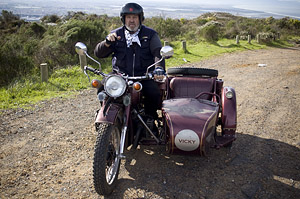
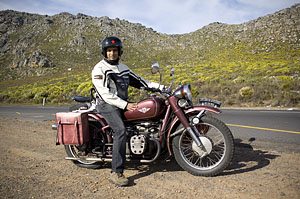
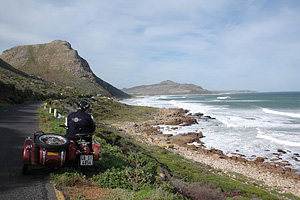
Riding a Vintage Motorcycle Sidecar Cape Town winters can get cold and wet. A North Western wind was expected to bring in the rains from Saturday to Tuesday. But thanks to an unexpected Northern wind, I woke up to a perfect Wednesday morning. Kevin from Cape Sidecar Adventures showed up at my hotel at 8 am sharp with Vicky, a vintage CJ750 from the '70s. Kevin was a large man in his early 60s with a short white beard. The route that Kevin had charted out took us through Camp Bay, Back Oven, Chapmans Peak, Hout Bay, and then the Constantia Valley between False Bay and Table Bay, Sun Valley, Snakes Head Lighthouse, Cape of Good Hope to Cape Point. He handed me a black and white leather bomber jacket and an open face helmet. I put on the jacket, strapped the helmet and braced myself in the sidecar. "The fishermen are a notoriously superstitious folk. They don't know this wind," Kevin said as he kick-started the bike. Vicky roared to life, and vroom, we were hurtling out of the city. Sunlight on my face, and a little bit of dirt in my mouth, we rode through the country side past various bays. We stopped at fishing marinas where showmen showed off their pet walruses. We took a break at an ostrich farm where a cute store sold egg shell lamps and novelties. Country homes sported high fences and signs on gates that read 'Protected by City Bowl Armed Response'. The roads were lined with 'Beware of Baboons' boards (I remember seeing a Nat Geo documentary on this one). Wood cutters cutting down alien vegetation along the roads waved at us vigorously. I am guessing motorcycles on the road were a rare sight for them.
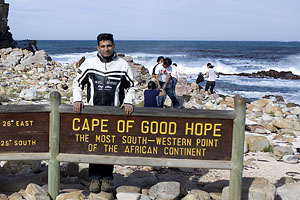
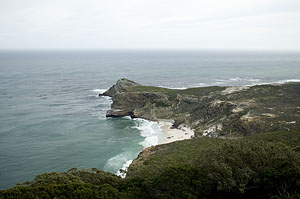
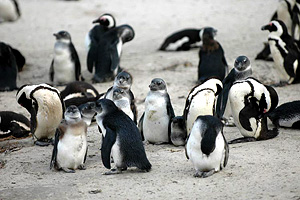
Where the Two Oceans Meet Soon, roads cut out of the country side and skirted along the Atlantic seaboard. The green waters belonging to the Atlantic Ocean were a gorgeous view and washed up a white surf to the shores of Table Bay. In the Table Mountain National Park, wild ostriches ran across the roads. Riding onwards, we reached the Cape of Good Hope. Now there was a misconception that Cape of Good Hope was the southern most tip of African continent where the cold Benguela current met the warm Agulhas current. The southern most point is actually Cape Agulhas and the currents meet somewhere in between of Cape of Good Hope and Cape Agulhas. Nevertheless, I made sure I took of picture of me with the signboard. Another short ride down south, we reached the Cape Point - a promontory at the tip of Cape Peninsula. A funicular took me to the view point on the top. It was a unearthly experience to see the Indian Ocean collide with the Atlantic. A restaurant, aptly named Two Oceans, sat perched on one of the cliffs. We walked in and I ordered the Pirates Platter while Kevin got a humble pasta. The food was delicious. Mine came with two king prawns, mussels, steamed line fish, calamari, rice, fresh lime and more. After lunch, we took a gorgeous scenic road along the deep blue False Bay of Indian Ocean. En route, we stopped at the nesting grounds of African Penguins on Boulders Beach near Simon's Town. More riding took us northward back to the city. We entered Cape Town as a pale orange sun began to slide down behind the trees along the highways. It was a gorgeous day well spent. There was more beauty than what could be absorbed by the eyes in a day.
DAY 4 - SHARK CAGE DIVING IN GANSBAAI
Overnight: Southern Sun, Cape Town
To Gansbaai for Shark Cage Diving At 5:01 am, my phone rang and Ibrahim announced himself. "You have a pick up for five. I am waiting for you in the lobby." I had just stepped out of shower and need another 10 minutes to get ready. At 5:09, the phone rang again and Ibrahim said, "I am running late. You are holding me up." I pleaded two more minutes, threw my cameras in the bag, hung a Do Not Disturb card on my hotel door and ran downstairs. By the time I reached the lobby, the receptionist was walking towards me. "Please hurry, Sir. He has already left." I ran outside the door and Ibrahim had started the car. We picked up five more people from Cape Town - a Peruvian couple, an American couple and an English girl. Gansbaai / Kleinbaai was about 180 km south east of Cape Town - a 2 hour drive by the road. And Ibrahim did a good job of getting us there, while all of us went back to sleep. At 7:30 am, we stopped outside the Great White House restaurant, a barn like white building with a wooden roof. Marine Dynamics, a shark diving and whale watching outfit welcomed its guests and operated out of here. I met the in charge Marilie and later the skipper of our boat Hennie. After a quick breakfast, Hennie took us through a short 15 minute briefing about the days plan. He was the man in control. We then put on our orange life jackets and boarded the boat - Shark Fever.
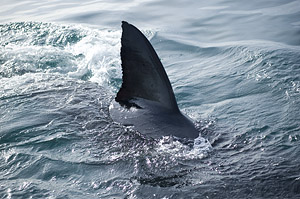
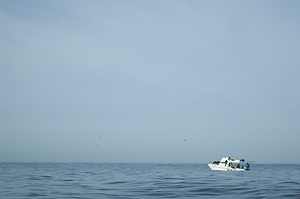
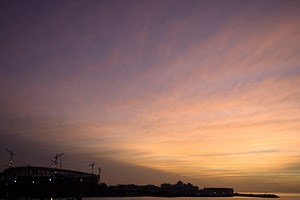
Swimming with Great White Sharks in the Atlantic Hennie anchored her off the Dyer Island. Beside it was another island Geyser Rock. And in between the two was a strait called Shark Alley. Dyer Island and Geyser Rock were breeding colonies for African penguins, seals and other marine life. Alex and Jonathan, the volunteers on the boat, got us into the diving suits. While Warran and Benz worked hard to "chum" the sharks. They threw in heads of Tuna and some salty fish soup to create an odour trail. Marine Dynamics picks up fish waste that is not fit for consumption/export for baiting. About five minutes after we anchored, Hennie called out, "Watch out on your left." A shark was mating with a seal and the seal was giving it a fight. The fight would last about five minutes and usually happens around sunrise and sunset, and we were lucky to catch it. The sharks were already there. While we were busy getting into the suits, a shark hit our boat! Everyone got into the suits. The waves rocked the boat pretty hard, and some of us, including me, got sick. Hennie had told us about it and it was pretty normal. I went to the edge to throw up and felt a little better. The first set of five people went into a cage that was lowered on the side of the boat. Strict instructions from Hennie said, "No limbs outside the cage. No touching the shark." We were just in suits. No breathing apparatus. The way to do it was to hold your breath and go inside the water. Stay there for as long as you could and then surface. We would float with our neck outside for most of the time and go in when the shark was around. In the next set of five, I got into the cage. The water of the Atlantic was cold. It started to seep through my suit and I could feel the chill. Some of it got into my mouth and I had to keep spitting to get the salt out of my mouth. Hennie or Benz or Warren would shout "Divers down down" and we would pull in a long breath and go in. The first time they did that, I took a deep breath and dipped into the ocean. And there she was! A huge 3m Great White. All the sickness, cold and salt was worth this one view. She circled the boat and with a quick dash of her tailfin, vanished into darkness. I came up and breathed heavily. Must have been like 10 seconds inside the water. "Divers down down down," they shouted. A deep breath again and in I went. The sharks came so close, I could touch them if I put my hand out of the cage. "On your left. Divers down," and down we would go. We had done about 15 such sightings. I was getting better. The body had adjusted to the cold water and I was breathing deep enough to stay out 30 seconds. It was surreal the sharks swimming a foot away from you. And then a large 3+ meters male just emerged from the bottom and headed for our cage. Thud and a micro second later, it vanished into the dark sea. It took us a few seconds to realize what happened, but it was all okay. We surfaced to the boat a few minutes later. I was completely drained out of energy. And it was good to be breathing with the nose again (as against mouth during the dive). But the boat was rocking pretty hard, and I felt sick again. After everyone completed their dives in the cage, we headed back for land. The trick, Jonathan told me, during sea-sickness is to focus on land (a fixed point outside the boat) and that really seemed to help. Hot beverages awaited us when we got back to the restaurant. Hennie took our leave and went back to the sea for another expedition exclusively for the volunteers. Lucas showed us the video he created on the boat - and it was superb! How he captured footage that did not need editing before viewing was mind blowing. Ibrahim drove us back to Cape Town through South African country side. When I got to the hotel at 2:45 pm, I was tired, tasted like salt and smelled like fish. So that was it. A brilliant experience swimming with the sharks. Unlike the zoo, this time around, the humans experienced the cage.
DAY 5 - WINERY IN PAARL, PATTING A CHEETAH IN STELLENBOSCH AND FRENCH FINE-DINING IN FRANSCHHOEK
Overnight: Le Quartier Francais, Franschhoek
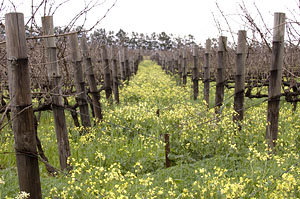
The Wine Route The weather continued to be kind. It was my fifth continuous clear and sunny day in Cape Town. Ameen, my guide from Day 2 picked me up at the Southern Sun. We started driving out on N1. Ameen started talking about why the Cape is also called the 'circle of saints' - several sheikhs who came in as slaves from Indonesia and Malaysia lie buried in this region. He had a very gentle style of speaking and it was a pleasure to listen to him. And like a good guide, he would inject his monologues with occasional wit and humour. We drove past olive plantations, oak trees and African fowls towards the towns of Paarl, Stellenbosch and Franschhoek. Our first stop was the KWV winery. KWV was established in 1918 as a co-operative to regulate wine production in Paarl. KWV is now a private company and is credited with shaping the wine industry of South Africa over the last few decades. The vineyards came to South Africa in 1652 with the Dutch. But the really good ones came here only in 1688 when the Hugenots came here fleeing prosecution in France. Christa Olivier of KWV took me on a tour of the winery. Since I was the only one around, it essentially became a private tour. When we pushed open the huge cellar doors, a strong aroma would hit my nose. Remember all those adjectives your waiter would splutter out when presenting a wine to you for tasting - woody, okay, plum, spicy, fruity - yeah, all of those and more. South African wine is still fermented in barrels imported from France and US. The South African oak grows too fast due to heat and does not have the same fine grain as European or American oak. One of the cellars, Christa told me, was also in the Guiness Book of Records for 5 largest barrels. At a capacity of 200,000 litres, the barrel emptied a bottle a day can last 750 years.
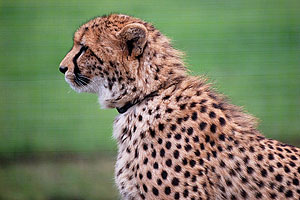
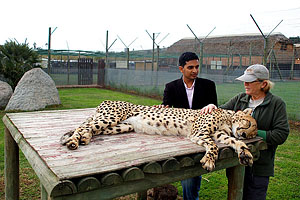
Patting a Cheetah We continued driving through beautiful winelands, although now dry because of winter. Some of the vineyards had rose plantations on the boundary. If you are guessing the roses are planted to give the wine a fragrance, hold your horses. They are there to detect any virus threats to the wines. We stopped at the Spier wine estate. Spier donated land to support the Cheetah Outreach Program that hand-raises cheetahs in the farm. For a donation of R90, you can pat an adult cheetah's. For R180, you can play with cheetah cubs. The donations support Cheetah Outreach Program and Cheetah Conservation Fund (CCF). After I made the donation, a volunteer was happy to take me inside the enclosure of an adult cheetah. "You will have to walk along the sides and approach Hemmingway from the rear. You can pat his back but please don't rub his face or tail. Be gentle with the cat. Use only your palms to pat him." the volunteer instructed. Hemmingway was a 4 year old young adult and at 60 kilos, it was already the largest cat on the farm. The cheetahs live for about 10-12 years in captivity. They would survive for about 8-10 years in the wild. The volunteer explained that many cheetahs were shot by farmers to save their livestock. Now the farm also breeds Anatolian dogs that can be given away to farmers. The dogs scare away cheetahs off the farms and therefore save them from being hunted. While the volunteer spoke about Hemmingway, I gently patted his back. A few minutes later, he rose from his lying position to sit up and purr. Remember, the cheetahs cannot roar. They can only purr. After a unreal fifteen minutes with Hemmingway, I stepped outside his enclosure. As I returned my badge, I saw a cute little board hanging on the gate: "Enter at your own risk" The cheetah is originally an Indian cat. It's such a shame that this magnificent cat is extinct in India!
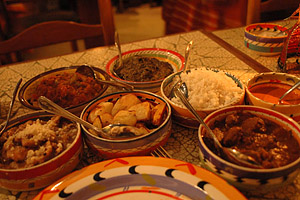
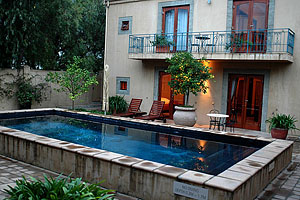
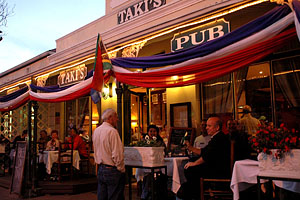
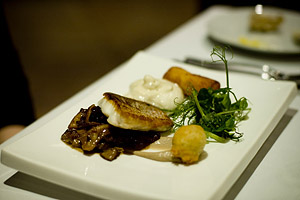
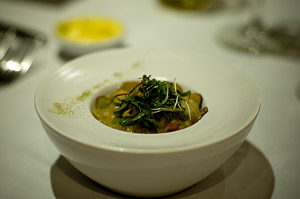
A Date with French Food in Franschhoek We drove past the varsity town of Stellenbosch to reach Franschhoek by evening. Franschhoek is a small town nestled in the lap of beautiful hills. Originally settled by Hugenots from France, the town still retains its French flavor. It was the eve of Bastille Day and the town was gearing up for the celebrations. Ribbons and curtains in French colors - red, white and blue - adorned all shops and businesses. The town goes to sleep at 6 pm but that is when the dining scene in Franschhoek comes alive. Local and international travelers flock to the superb restaurants and bistros in Franschhoek to experience the French culinary delights. I stayed at Le Quartier Francais, an auberge with exclusive accommodation and an excellent restaurant in Franschhoek. As our car drove into Le Quartier, Linda Coltart, the General Manager of the property came out to greet us. While we made our introductions, my luggage shifted with magical accuracy and invisibility from the car into their luxury suite - The Four Quarters. It was as if all life in Le Quartier was in precision mode. I walked into the reception with Linda to meet Susan Huxter, the owner of Le Quartier. The reception was a glowing room with an active yet invisible staff, a huge DVD collection on one wall and a cat on the sofa. Susan extended a warm welcome and kind of surprised me as she had already seen my blog before we met. She asked where would I prefer the evening dinner - the tasting room or the restaurant. Le Quartier's tasting room and restaurant have been voted as the best in Asia, Africa and #37 in the world. The tasting room offered a delightful French meal of eight courses carefully paired with wines. "I have arranged for Eleanor to accompany you on dinner this evening," Susan said. Eleanor was Le Quartier's Food and Beverages manager. "Eating alone is too boring," Susan shook her head. "I would never do that." The meal lasted a little shy of three hours. Jasper, a graduate from a hospitality school in Netherlands who was on a 20 week internship with Le Quartier, waited on us. As we progressed through the courses, the plates, forks and glasses moved around us like a synchronized ballet. The chef, Margot Janse, threw in another two complimentary courses in the eight course meal. The courses sometimes were made with local seasonal produce - fresh pomegranates or juicy crabs from the Namibia coast. Were those 3 hours a long meal with conversations? Or a long conversation with meals in between? At the end of it, I was so full, I could have died and gone straight to heaven. Eleanor joked, "Oh, please don't worry. Our rooms are downhill from the tasting room. And we have a wheel barrow right outside the restaurant should one collapse."
DAY 6 - THE FLIGHTS BACK HOME
Franschhoek to Cape Town to Johannesburg to Bombay It was almost impossible to tear myself out of Le Quartier's luxurious bed in the morning. Such a shame that I had to leave for the airport before the dawn broke. On our way to the Cape Town airport, we drove past the Khayalitsha and Langa townships. Khayalitsha was the largest township in South Africa and at a population of 450,000, it accounted for almost 1% of South Africa's population. At the airport, I thanked Ameen for his hospitality and slipped a note between his palms when I shook his hand. He resistantly took it and said, "Shukran Jazakallah." That morning, I learnt a new way to say 'thank you'. After a short flight out of Cape Town, I was joined by Chhavi, Hrish, Swapnali and Rohit at the Johannesburg airport. Bombay beckoned.
Notes on Travel Photography I think my gadgets out-weighed my clothes on this trip (and I am guilty for this). Two Nikon DSLR bodies - D70 and D50. Three Nikkor lenses - 24mm 2.8, 50mm 1.4, 70-200mm 2.8. One point and shoot - Canon G10 (also doubled up as a video recorder). Laptop - an Apple Macbook. Two phones - HTC and Blackberry. Music - iPod 80 Gb. Bag - Nat Geo 5162. A big thank you to Kiran Patil and Nishant Vats for lending me their photo gear on this trip! Every trip brings more wisdom about travel photography. This trip reiterated the learning that it's a joy to shoot with two camera bodies. I also loved the light-weight wide and normal primes. The long zoom lens that I carried on the trip was a sheer masterpiece and provided new unexplored perspectives. But it was too cumbersome to carry it around the neck. However, I must admit that this trip was a poor crop in terms of the number of shots I really loved. I just couldn't peel the layers of Cape Town. So what's my ideal traveling kit? Two bodies - 1 FX and 1 DX - both with video recording capability. Three prime lenses - 20mm 2.8, 50mm 1.4 and 85mm 1.8. One teleconverter - TC 1.7. One point and shoot - 10+ mp, 4x zoom, video and RAW options. One bag that can accommodate all of this and go into the plane cabin. One bag that can accommodate two bodies with lenses and can be carried around while walking.
IN THE NEWS: Hindustan Times, The Times, Business Standard, Aloo Techie, Indian Television, Better Photography PLAN YOUR TRIP: Flights - Cleartrip.com, South African Airways / Stay - Protea Hotels, Southern Sun, Le Quartier Francais / Eat - Nyoni's Kraal, Willoughby & Co, Two Oceans Restaurant, Africa Cafe, Moyos, Le Quartier Francais / Wine - KWV, Spier / Tours - Cape Capers, Cape Sidecar, Marine Dynamics, Cheetah Outreach / Give - Ikamva, Cheetah Conservation Fund / Currency - 1 ZAR = 6.25 INR
Tags: Adventure Sports, Africa, Wildlife